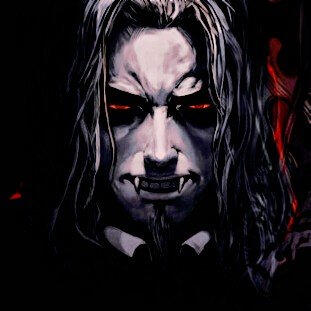
Count Dracula
I
Biography
The story of a tactician who became the Prince of Darkness; Count Dracula.
Powers and Abilities
Revel and despair at the mighty, fearsome power of the Count of Wallachia!
Depiction
Archive on the physical appearance and personality of Wallachia's Count.
Biography
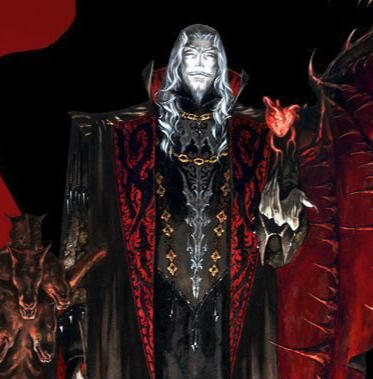
1094:
The man later known as Dracula was originally born Mathias Cronqvist. Sometime during the mid to late 11th century, he served in a company of knights alongside then Baron Leon Belmont. With Mathias's brilliant military strategies and Leon's skill with a sword, their company was unstoppable. Little is known of Mathias's early life or his family, save that they seem to have been longtime practitioners of Alchemy and had advanced further into the study than most alchemists could have ever dreamed. Mathias was very well educated and quite skilled in the art, though he never told Leon or any of his other compatriots of his knowledge, with the notable exception of Rinaldo Gandolfi, whom he had met at an unspecified time. Mathias married a woman named Elisabetha who he was deeply in love with. While away on a campaign against heathens in the east, Elisabetha died due to illness. Upon returning and learning of her death, Mathias was overtaken with despair so profound that he became bedridden, presumably worrying Leon considerably, as Mathias was the strategist and tactician of the company.
During that time, Mathias grew angry at God for allowing Elisabetha to die such an early death while he was away risking his life and fighting in God's name. He thought it was unjust and unfair for God to take away what mattered most to him, when he had given God so much and when Elisabetha was such a pure and blameless woman who has not deserved to die. Mathias began searching for ways to become immortal and show God that he didn't have a final say in everything and that he could defy God's decrees by existing outside them and scorning God in his eternal life. He learned about the Crimson Stone, considered to be a treasure among vampires. Through some means, the stone came into Mathias's possession and he planned to use it to ascend to immortality.
Through his acquiring the arcane relic, an evil deity known as Death bound himself in servitude to Mathias, as Death would only follow he who controlled the Crimson Stone. With the stone, Mathias could not only control the powerful spirit creature, but also absorb the souls of slain vampires and add their powers to his own. As an effect of this, humanity would be lost and he would become a vampire himself. The young knight then had all the resources he needed to plan his scheme to become an immortal. Mathias eventually came in contact with a powerful Vampire Lord named Walter Bernhard, who had somehow obtained the Ebony Stone, another vampiric treasure that locked his forested realm and castle in eternal night, thereby making him the most powerful vampire. The only thing of value that Walter desired was the Crimson Stone, which was believed to be lost for ages, but was secretly held by Mathias.
The vampire was bored due to his own immortality and in order to distract himself from that, he enjoyed playing life and death games with brave humans. To raise the stakes of the game - to make the human more interested - he would steal that which is most precious from his target. Mathias suggested targeting Sara Trantoul to Walter, the fiancée of Leon Belmont. The knight would make an interesting player in Walter's game, because according to Mathias's stories, his combat prowess was second to none. Walter, who didn't realize he was being tricked, ordered his forces to invade Leon's domain in order to capture Sara.
All went according to Mathias's ingenious plan; Leon went to Walter's castle to save Sara and due to a series of planned events, was able to defeat Walter. When Walter was dying, Death appeared and took his soul and granted the vampire's power to Mathias, who had materialized in the castle. It was only in his final moments that Walter realized what was happening and what Mathias's true intentions were. Due to absorbing Walter's soul, Mathias became the most powerful vampire, though the Ebony Stone eluded him, as it was destroyed in Leon and Walter's battle.
Mathias then declared that he had never spent a better night and gave Leon his gratitude. A confused Leon demanded an explanation, to which Mathias replied that he needed a powerful vampire's soul and he knew that Leon had it in him to destroy Walter so that he could take the soul. Leon sensed a rage from the Vampire Killer, which he used to kill Walter and asked in disbelief if his best friend had abandoned humanity. Mathias confirmed this and revealed his motive. He admitted that everyone involved in the ordeal were just pawns in his plan to become the most powerful vampire and curse God forevermore because of God's cruelty. Mathias then offered Leon eternal life as he too suffered over the death of his beloved. Leon refused, because eternity without the one he loved would be empty and Mathias's twisted plan had cost Sara her life. Mathias believed that Leon out of all people would be the one to understand him, but when that wasn't the case, he became a bat and flew away and the two would never meet again, also ordering Death to dispose of Leon.
Mathias went in hiding in foreign lands and he continued to curse God. Eventually, he named himself Lord of the Vampires and King of the Night.
1094-1476:
At some point during Mathias's unholy life, he built a magic castle in the province of Valachia where he would recruit humans and other beings who had turned their back on God, or were shunned by the light. Mathias granted some of them the forbidden knowledge of Devil Forgery and allowed them to practice their rites in his castle.
One day, he met a kind woman named Lisa, with whom he would eventually become romantically involved. She reminded Mathias very much of Elisabetha, which was mostly the reason why he had fallen in love with her. Lisa loved Mathias very dearly despite his views on life and they would eventually have a son together named Adrian Fahrenheit Ţepeş, who would be later known as Alucard.
Eventually, rumors started to spread that Lisa's medicinal practices were a form of witchcraft. This caused her to be arrested and sentenced to death by the authorities. Lisa was captured and crucified, an event Adrian witnessed but was prevented from intervening in. As the execution would have traditionally occurred during the daylight hours, Mathias would not even become aware of it until hours later and when he learned of this, it drove him over the edge. Eventually, he changed his name to Dracula Vlad Ţepeş and plotted his revenge against mankind for ruthlessly taking away what mattered most to him.
1476:
Dracula, angered at humanity for the loss of Lisa, sent his legions against the people of Europe. The church sent many armies in opposition, but none returned.
After several months, Dracula's forces had almost completely wiped out the armies sent by the Eastern Orthodox Church and had conquered whole countries. One night, Isaac, a General in Dracula's army, reported the Belmont Clan had started an offense in the west. A vampire hunting descendant of Dracula's old friend, Leon, who went by the name Trevor C. Belmont, was planning to assault Dracula's Castle. Because Dracula was responsible for the death of Leon's betrothed, Sara, Leon committed his kinsmen to hunting down and destroying Dracula. Isaac requested the opportunity to face Trevor himself. Instead, he was sent to find Hector, another General who was previously ordered to assassinate Belmont, but had deserted. Dracula planned to meet his old friend's descendant himself and waited for the hunter in his throne room.
Dracula eventually faced the vampire hunter along with the rebel, Grant Danasty (who had earlier been turned into a demon by Dracula's forces in a failed attempt at overthrowing him before Belmont freed him from the curse), the sorceress Sypha Belnades and his own son, Alucard, who had chosen to oppose his father. With much effort, the Vampire Lord was finally slain. For the first time in hundreds of years, the immortal Dracula was at last dead, though his scheme to decimate humanity had not ended. With his final breath, he uttered a curse that left the land to rot while poisoning the minds of its inhabitants, who pillaged and scourged it without remorse.
1479:
A few years later in 1479, Death sought to resurrect Dracula by using the Count's traitorous Devil Forgemaster General Hector as a vessel for Dracula. Because Devil Forgemasters were suffused within Dracula's magic, only they could make suitable hosts for the Count to inhabit. However, they would have to be fully enveloped within the curse that Dracula left behind that was plaguing the land and its people.
Though Hector was Death's (who disguised himself as Zead) ideal choice for a body for Dracula's reawakening, he rejected the Curse, causing Death to compromise and use Isaac for the vessel. Isaac was killed in cold blood by Hector and Death used the corpse to resurrect the Count, causing the first reawakening of Dracula from the dead. Dracula intended to execute Hector for deserting him earlier, especially after learning that Hector did so due in disgust toward Dracula's genocidal aims against humanity. However, because the resurrection was only partially successful, Hector was able to thwart both Death and Dracula and send the Count back to the grave, as well as nullify his curse, finally freeing the land from its venomous grip.
1691-1698:
Dracula rose again in 1691 on an Easter night when his followers convened in a monastery to perform the unholy ritual to return him and his castle to the world and plunge mankind into darkness and despair. Dracula was defeated by Simon Belmont, but not without dealing a critical blow to Simon's back and casting a curse on him. Similar to when he was defeated by Trevor Belmont in 1476, Dracula left a curse on the land before his passing.
Though Dracula was dead, he left both Transylvania and Simon Belmont in dire condition. The only way to expel his curse was to collect his remains and destroy them within the ruins of Castlevania. Dracula's monstrous followers had free reign over many territories in the land while Transylvania was cursed and they hid the Count's remains in heavily guarded mansions. The weakened Simon Belmont retrieved all of the remains in 1698 and took them back to Dracula's Castle, where he burned the remains he had recovered. To Simon's surprise, however, Dracula's ghost manifested through the Fang of Vlad, a remain unknown to Simon and tried to destroy him, but Simon defeated Dracula again, lifting the curse from the land and from his own body.
1792-1797:
Dracula revived in 1792, one hundred years after his defeat by Simon Belmont. He was brought back by the zealous dark priest Shaft and his congregation, who sacrificed a maiden to resurrect the Count and his castle. When Dracula returned, he dispatched his forces to pillage the land. They kidnapped young women from a village, one being Annette, girlfriend of Richter Belmont. The Count sensed the connection she had with his mortal foes and, moreover, was taken with her beauty. He offered her immortality so she could rule the world by his side, but she refused him, saying she would rather die. Richter eventually rescued all the maidens from Dracula's clutches, slew Shaft and defeated the Count. At this time, Dracula had become amused by the never ending cycle he shared with the Belmonts. He knew he would return, so he wasn't dismayed by his defeat. Richter told him he had no place in the world, but Dracula said that it was not his choice that he continued to return. He comes back through the will of humans that call upon him. Because of that, Dracula asked Richter if he could truly be called evil. Richter then told Dracula that while it was true that humans have had evil desires such as power, they also had other, good desires as well and declared that evil will eventually fall permanently. As he was disintegrating, Dracula, while conceding Richter's claim that evil would eventually be vanquished, nonetheless laughed at him in full confidence that he would return and that the Belmont's hunt was in vain.
Although defeated, Dracula returned five years later in 1797, due to the efforts of Shaft's ghost. This time, it was his son, Alucard, who confronted him. Dracula was somewhat shocked to see his son again and awkwardly tried to convince him to see things from his point of view. He was upset about him constantly siding with the humans, despite everything they had done. He asked him if he had forgotten what the humans did to his mother, Lisa. Alucard replied that he would never forget such an atrocity, but unlike him, he did not seek revenge against them, because that is not what his mother would have wanted.
Alucard told his father that he could not allow him to plague mankind yet again and the two family members came to blows. Because Dracula's resurrection was not complete, he was defeated by his son. At the end of the battle, Dracula set everything aside and only wanted Alucard to tell him Lisa's final words. Alucard told his father that she said to not hate humans; that if he could not live with them, then at least do them no harm. She also told Alucard to tell his father that she would love him for all of eternity. For the first time in hundreds of years, Dracula was regretful for what he had done. He called out to Lisa to forgive him for his transgressions and said his goodbyes to his son as he faded away in death.
1900:
Dracula rose sometime in the 1800s. After 1797, the Belmont Clan faded away and other organizations emerged with the hope of holding back Dracula and his forces in the Belmonts' stead. The most successful group was Ecclesia, due to Barlowe, the leader of Ecclesia, making a breakthrough discovery with the creation of Glyphs, symbols that utilized the power within all things, which the Ecclesia members were able to use in combat.
Because of Ecclesia's success, those in positions of power entrusted the organization with Dracula's bodily remains so that they may destroy the remains and hopefully end the scourge of Count Dracula for good. Barlowe developed the ultimate glyph, Dominus, from the remains of Count Dracula. Barlowe used the cover story that Dominus would be used to destroy the Dark Lord, but in truth, Ecclesia's true purpose was to fulfill the wish of mankind, which in Barlowe's mind was the resurrection of Count Dracula. Barlowe's plan was to use Dominus to destroy the seal on the remains that prevented Dracula's reemergence in the world. Barlowe needed someone to host the Dominus Glyphs and he chose his disciple, Shanoa, who was unaware of the true intent of Ecclesia and that using Dominus would end her life. Shanoa discovered the truth and defeated Barlowe. The remains of Dracula then surged large amounts of dark energy into Barlowe, which he was able to use to resurrect Dracula at the cost of his own life. After Barlowe sacrificed his life force to the bodily remains, the Dark Lord and his castle returned yet again.
Shanoa infiltrated Castlevania and made her way to the Throne Room where Dracula ruled over his castle and subjects. Initially, Dracula thought that Shanoa was the one that brought him back and asked her if she wished for eternal life or a place at his side in return for her service. Shanoa told the Count that she had in fact gone there to destroy him. Dracula was amused by her response and welcomed her challenge, telling her that he had not danced in a while. Shanoa's own power was not enough to destroy Dracula, but when she used the Dominus Glyphs that she was hosting, to the Count's surprise; she was able to defeat Dracula with his own power, sending him to his death.
Powers and Abilities
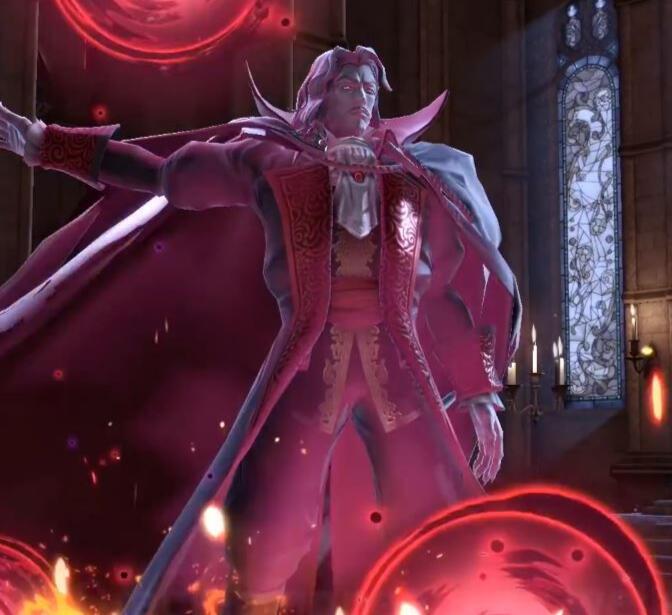
Power-Scale Summary:
Dracula is generally Solar System level (4-A), but can easily go higher to about Universal (Low 2-C) based on abilities and feats demonstrated in-game across his attack potency, durability, and speed.
Origins:
Count Dracula is an immortal vampire holding the position of Dark Lord, who draws upon the power of Chaos and is looked upon as the King of the Night and the embodiment of evil. Many lesser creatures of darkness and obsessive humans are fanatically devoted to him and subscribe to the belief that he will cleanse the world from its sullied state and bring about a new order. Their belief in this is so strong that until his regeneration cycle ended in 1999, Dracula was certain to return after death due to his servants yearning for him. Because of this, Richter Belmont accused Dracula of stealing the souls of men and their freedom. Dracula rebutted that freedom is always sacrificed to faith and asked Richter if he was truly before him by choice. Earlier in the same conversation Dracula said that the world invited him to return, with humanity calling him with praise and tribute.
The Crimson Stone:
Dracula's power ultimately came from his possession of the Crimson Stone, which he never lost. With it, he absorbed the soul of a dominant vampire lord, Walter Bernhard, thus gaining his powers. Dracula came to resemble Walter by having his own magical castle, legions of monsters, as Walter did before him and even using some of Walter's attacks. Furthermore, Dracula's ability to repeatedly return from the dead may have been inherited from Walter Bernhard, as after being defeated by Leon Belmont, Walter said that with his powers, he would surely come back to life.
Dark Lord:
Dracula is the Dark Lord, or Demon King. He is the entity opposite to God's Order and Goodness, embodying instead both Chaos and Evil. Without evil there could be no good, and without the Dark Lord to act as a force of absolute evil, God's goodness has no meaning. As Dark Lord, Dracula rules over The Abyss (Hell) and its innumerable demons. Dracula draws power from The Abyss, while simultaneously sustaining The Abyss' very existence.
Power of Dominance:
The Power of Dominance is the primary ability of the Dark Lord. Through it, Dracula gains absolute control over the souls of demons. As Dark Lord, Dracula's will extends across all demons, and they owe their very existence to Dracula's power, being as much a part of him as Dracula's own Demon Castle. With the Power of Dominance, Dracula can bend the demonic spirits to his will, absorb the souls of demons to obtain their powers, or even erase their souls from existence.
Power of Chaos:
As Dark Lord, Dracula acts as the physical herald of Chaos, the abstract entity who is the embodiment of root of all Evil and Chaotic things. Dracula's very existence is one connected to the Chaos within the heart of every human, with every chaotic thought and feeling produced by humanity empowering him. Similarly, as long as humanity exists and continue to have a chaotic existence, Dracula will never truly die. In combat, Dracula can tap into Chaos' power directly, allowing him to transform into his most powerful form.
Power Over Death:
Out of all of Dracula's myriad demonic servants, one stands above the rest: Death, the Grim Reaper. Death is, as its name implies, the God who embodies Death and who collects the souls of all mortals at the end of their lifetime. Death's connection to Dracula goes beyond that which he holds with other demons, as the two became allies when Dracula was still a human. The two hold mutual respect and friendship, and Death is Dracula's confidant and Right-Hand Man. However, despite all his divine powers, Death is still just another demonic soul under Dracula's control, fully susceptible to his master's Power of Dominance.
Demonic Army:
As the Dark Lord, Dracula holds control over nearly every demonic entity safe rare, abnormal exceptions. As all demons are his servants, fully bound to his will, Dracula commands large legions of demons, monsters, undead warriors and other entities of the Night. Every time Dracula resurrects, his armies shall rise with him.
Vampire:
Dracula is a vampire, an immortal undead entity who haunts the Night. More specifically, he is the Vampire King. Vampires can be considered "Demonic Royalty", both for their air of nobility and often elegant appearance, but also because their power far exceeds that of most demons. They possess both incredible physical strength and vast dark magical abilities, and usually hold an intrinsic connection to the Chaos in human hearts. As the King of All Vampires, Dracula is the strongest of his race, and is revered by lesser vampires as a God.
Immortality:
As a Vampire, Dracula is immortal. He is immune to aging and is not susceptible to any earthly disease. Even if he may be killed, his soul shall remain immortal within The Abyss, and within 100 years he shall return to the world of humans, stronger than before.
Invulnerability:
As a Vampire, Dracula is effectively invulnerable. No weapon from the human realm can harm him, and even weapons with magical and alchemical origins are useless against him. He is susceptible to damage from Holy Weaponry, such as Angelic or Saintly Swords, Magical Holy Water, etc; However, they will still not kill him. Only very specific Weaponry such as the Belmont Clan's Vampire Killer, Alucard's Sword and Spear, and Shanoa's Dominus, can kill Dracula.
Bloodsucking:
As a Vampire, Dracula can feast on the blood of human victims for his pleasure, sustenance, and to increase his energies. He may suck a person's blood the traditional way, by biting into their neck, but he is perfectly capable of draining someone's blood through touch alone.
Power Over Humans:
Vampires are influential and seductive creatures, whose dark aura extends into the hearts and minds of men. They can easily control human minds, often passively, turning them into their mindless slaves, possessing them, or even charming them. They can influence their hearts and lead them to evil, as seen when Carmilla started the Witch Hunts across Europe by whispering into the hearts of men. Human souls can also be easily controlled by vampires, as seen when both Elizabeth Bathory and Brauner wielded the souls of the deceased in World War I and II for their purposes.
Dracula's Curse:
Dracula is capable of cursing humanity as a whole through Dracula's Curse. The curse is pestilent, and festers in the hearts of humans over time, corrupting them into insanity and murderous rage. If not stopped by Hector in 1479, Dracula's Curse could have destroyed all of mankind.
Shapeshifting:
As a Vampire, Dracula is a skilled shapeshifter, being capable of assuming a variety of demonic forms for his dark purposes. Out of these, three are the most important:
Bat Form:
Dracula may transform into a single bat, or into a gigantic swarm of bats for transportation and to overcome his enemy through sheer numbers and disorientation.
Wolf Form:
Dracula can transform into a wolf to gain increased speed, and destroy his opponent with rapid charging attacks.
Mist Form:
Dracula can transform into a cloud of mist, becoming intangible and thus immune to physical harm. Said mist is also often poisonous in nature.
Magical Powers:
As the Dark Lord, and King of all Vampires, Dracula possesses unrivaled mastery over Dark and Chaotic Magic. As he who controls Chaos, Dracula's power is unmatched only a few foolish demons ever dare to challenge his Throne.
Hellfire: A classic attack Dracula is fond of. With a wave of his cape, the Count releases a trio of hellish fireballs to scorch his opponent.
Dark Inferno: A more powerful variation of the Hellfire attack. Waving his cape, Dracula fires a pair of dark, meteoric orbs of darkness that bring great destruction.
Dark Metamorphosis: With this spell, Dracula greatly enhances his vampire Blood-Draining abilities.
Dark Void: With this spell, Dracula can teleport as a black mist of bats.
Demonic Cleansing: Dracula summons a gigantic pillar of scorching hellfire to destroy his opponent.
Dark Blaze: Dracula summons pillars of dark magic to destroy his opponent.
Soul Steal: An incredibly powerful spell that allows Dracula to rip and absorb the souls of nearby enemies, devouring their essence and vitality and converting it into power.
Blood Storm: In a mockery of the Belmont's Hydro Storm, Dracula can provoke a rain of acid blood.
Meteor Shower: Dracula can cause a barrage of flaming meteors to descend from the skies and destroy his opponents.
Demonic Meggido: The Demonic Meggido is Dracula's ultimate magical attack. Spreading his arms and charging his power, demonic runes manifest before Dracula as his magic concentrates into the form of a gigantic sphere of destruction, which is fired at the opponent provoking a huge explosion. Dracula can also fire this attack as a gigantic spherical wave of destruction with him as its center.
Depiction
Appearance:
Dracula has been depicted many different ways over the course of the series. His appearance changes in nearly every game he is in. In the earliest titles, Dracula has a rather ethereal appearance, presenting himself as a very decayed and aged man with a long red cloak in the original Castlevania on the Nintendo Entertainment System. This look was taken even further in Vampire Killer, where he has no flesh on his body and his bones are exposed. In Castlevania II: Simon's Quest, he greatly resembles Death. He is shrouded in a black mantle and his face is that of a skull.
Dracula's in-game depictions are very different from his appearance in the official art for those games, which display him as a more atrocious version of the Béla Lugosi vampire stereotype with a widow's peak hairstyle. He reflects this image in such games as Haunted Castle and Akumajō Dracula (X68000), in which he wears a tuxedo with a cape. In some cases, such as Symphony of the Night, he is also depicted with shoulder-length and unkempt white hair as well as a goatee, which bore some resemblance to how Bram Stoker's Dracula described him in the narration.
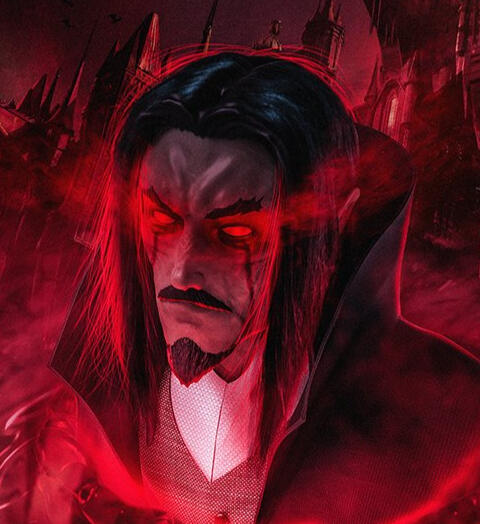
Sometimes Dracula sports a dark sorcerer like appearance with long flowing robes as seen in Castlevania III: Dracula's Curse and Castlevania: The Adventure. In Castlevania: Rondo of Blood, Dracula appears as a young man with purple hair. Aside from displaying certain Japanese anime clichés, he still wears attire like he did in earlier games, like a tuxedo and a long dark cloak.
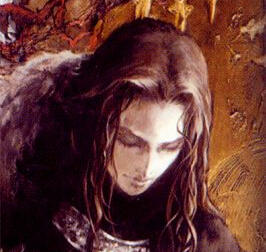
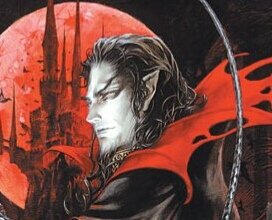
When Ayami Kojima became the regular illustrator of the series, Dracula took on an especially regal air with lavish clothing, as seen in Castlevania: Symphony of the Night, Castlevania: Harmony of Dissonance and Castlevania: Curse of Darkness. Dracula's appearances have been very inconsistent over the years. Sometimes he is an old man, other times he is young (Castlevania: The Dracula X Chronicles, Castlevania: Portrait of Ruin); sometimes he's ghostly, other times he appears fairly regular, but he always retains vampiric archetypal traits. As a human, Dracula was Mathias Cronqvist, a young man with long dark hair and light blue eyes.
Regardless of how he appears in various games, Mathias and Soma Cruz notwithstanding, he is generally shown to have a very tall disposition, appearing at least twice as tall as his opponents in his more "human" form, usually requiring that his opponents jump to hit him.
Personality:
Dracula has shown a certain level of inconsistency regarding his personality, although common elements have been an outstanding malice regarding the human race and God and a well defined superiority complex (he thinks every creature is inferior to him) when confronting his enemies. When facing his son, Alucard, Dracula shows a softer side and a clear love for his son and also expresses his eternal love for Alucard's mother as well. After his death in 1797, Dracula becomes much more consistent and seems devoid of many emotions, though the hostility and superiority complex still remain.
Some of his most consistent traits however are his deep cruelty and indifference to all the destruction he brings with him, while somewhat taking pleasure on the suffering he inflicts on others. He also justifies his actions by claiming that it is not by his power that he comes back, but through the malice of humans that makes his return possible, going as far as questioning whether he is truly "evil" because of this.
Despite being challenged and defeated numerous times by the Belmont Clan, he always seems to play with them at first before using his full power, possibly underestimating them while at the same time enjoying his battles with the family, something he does mention from time to time as he even looks forward to his next encounter against the Belmonts after being defeated.
However during his defeat in 1797, he actually feels for the first time regretful of his actions after knowing of Lisa's wish for him, although during his subsequent revivals he seems to feel nothing of that. A possible reason for this could be that the evil of humanity ensures that Dracula remains constantly evil and as such an embodiment of malice. Whenever Dracula's background is explained he often becomes what he is as a result of the loss of his loved ones and thus he can be seen as a rather tragic villain. In addition, upon being defeated by Alucard the second time, he implies that, despite being at war with God, he still retained some knowledge of the Bible, as he quoted the Book of Matthew's warning about losing one's soul in their pursuit of gaining the world. In addition, he also seemed genuinely impressed that innocence remains even in a world filled with evil when being beaten by Maria Renard.
Unlike many recurring video game villains, Dracula is never really seen abusing his minions in any way. In fact he addresses to any of his subordinates respectfully and politely whenever he engages in any conversation and even extends this trait to his enemies. He is also shown to be fairly grateful, as he often blesses and rewards those that serve him or otherwise helped in his resurrection, be it directly (as in the case of Shaft) or indirectly (like Shanoa) by usually offering power, a high rank within his army or even immortality. However, he is shown to be merciless toward any minions of his that defect from him, which is especially evident in how he intended to execute Hector for treason immediately upon being revived, although he nonetheless implored the latter regarding his reasons for doing so.
When he is manifested through Soma Cruz, however, Soma's personality is much more aggressive and sadistic than Dracula usually is. He murders Celia partly out of anguish for Mina's supposed death, but mostly because he finds her infuriatingly annoying, despite the fact that it was Celia who brought Dracula back into the world. When Julius, Alucard and Yoko confront Dark Lord Soma at the end of Julius Mode, he taunts them throughout their battle, more so than Dracula's usual manner of taunting. Similarly, his manifestation through Soma, or rather, a facsimile created by a grimoire catalogue, was shown to recognize Alucard, and shown to have a grudging sense of obedience to Hermina due to wishing to continue fighting despite being close to defeat.
Whenever encountering his opponents, he generally holds a wine glass that presumably contained blood, only to toss it aside at their feet before promptly fighting them.